Summary:
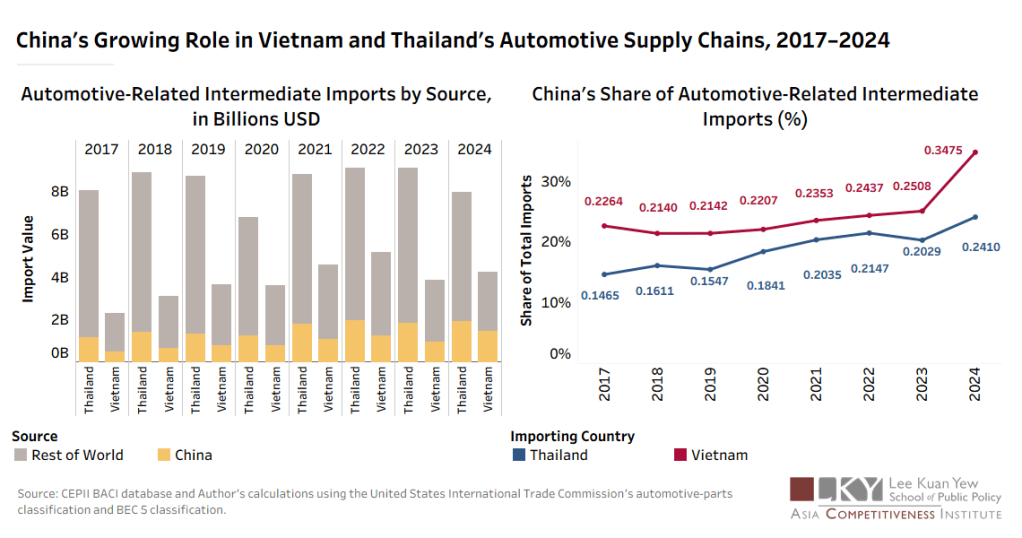
China became a more prominent supplier of automotive-related intermediate goods to Vietnam and Thailand between 2017 and 2024. Using CEPII BACI trade data, along with the United States International Trade Commission’s automotive-parts classification, this Chart of the Week examines both China’s share of these imports and the value imported from China compared to other sources.
China’s share of automotive-related intermediate imports increased from 22.6% to 34.8% in Vietnam and from 14.7% to 24.1% in Thailand. The annual data reveal different patterns: in Vietnam, China’s share remained between approximately 21% and 25% through 2023 before rising sharply in 2024; in Thailand, it increased more gradually, with some fluctuations.
The increase occurred against different overall import trends. Vietnam’s total automotive-related intermediate imports expanded from US$2.29 billion in 2017 to US$4.22 billion in 2024, an increase of 84.2%, alongside the development of its emerging automotive production base. In Thailand, an established regional automotive manufacturing hub, total imports were broadly unchanged between the two endpoints, at US$8.05 billion and US$7.97 billion respectively. China became a more prominent supplier in both economies despite their different overall import trends and stages of automotive industry development.
These changes highlight China’s growing role within the two economies’ automotive sourcing networks. International sourcing can give manufacturers access to inputs that complement domestic production. However, greater reliance on Chinese suppliers may also increase exposure to supply disruptions and trade-policy uncertainty associated with US–China tensions. Restrictions affecting inputs sourced from China could have implications for manufacturers in Vietnam and Thailand, particularly where alternative suppliers are difficult to access. Developing local supplier capabilities and maintaining diversified sourcing options can help both economies manage these potential risks.
Highlights:
1. China’s growing supplier role. By 2024, China supplied 34.8% of Vietnam’s automotive-related intermediate imports and 24.1% of Thailand’s, up from 22.6% and 14.7% in 2017.
2. Different industrial paths, a shared sourcing shift. China’s share of automotive-related intermediate imports increased substantially in both Vietnam’s emerging automotive production base and Thailand’s established automotive manufacturing hub.
3. Potential exposure to supply disruptions and US–China trade tensions. Greater reliance on Chinese inputs may increase exposure to trade restrictions and supply disruptions, reinforcing the importance of diversified sourcing and local supplier development.
Article By MA, Qi Xiang
Graphic By Parag, DASS

