Summary:
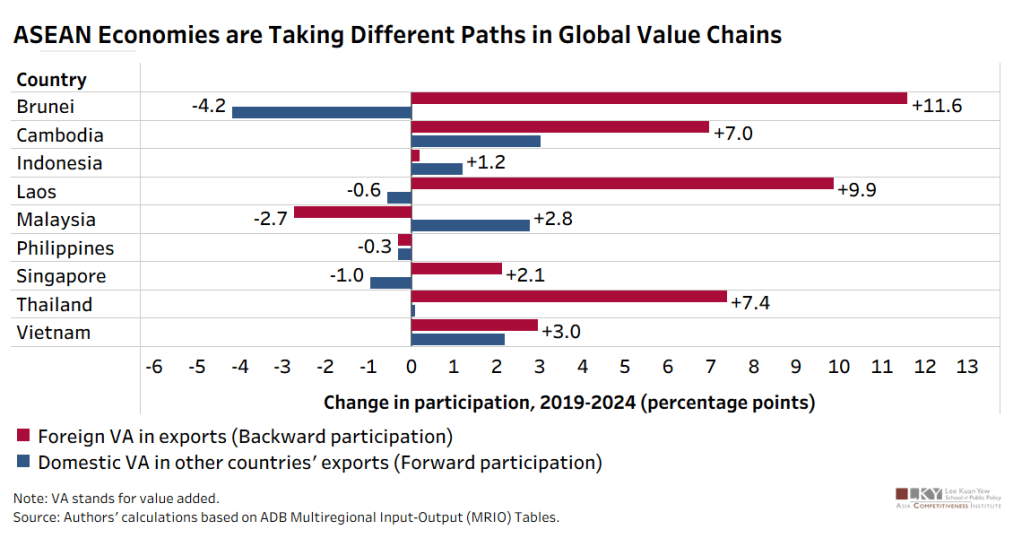
Using the ADB Multiregional Input-Output (MRIO) Tables, we measure how nine ASEAN economies shifted their GVC positions between 2019 and 2024, comparing the change in backward participation (the foreign value added embedded in a country’s exports) against the change in forward participation (the domestic value-added it supplies to other countries’ exports).
ASEAN’s integration into global value chains (GVC) is a story of divergence rather than a shared regional trajectory. Several economies – led by Brunei, Laos, Thailand and Cambodia – recorded large increases in the share of foreign value added in their exports. Malaysia moved the opposite way, pairing a lower backward with a stronger forward participation, while Vietnam and Cambodia simultaneously increase both backward and forward participations.
The changes suggest that ASEAN economies entered the post-pandemic period with different GVC dynamics. Some economies have become more reliant on imported inputs, while others strengthened their role as suppliers of value added further along international production chains.
Highlights:
1. Backward participation surged in several economies. Brunei recorded the largest increase at 11.6 percentage points (pp), followed by Laos (+9.9 pp), Thailand (+7.4 pp) and Cambodia (+7.0 pp). This indicates a greater share of foreign value-added embodied in their exports in 2024 than in 2019.
2. Singapore and Malaysia showed contrasting movements. Singapore leaned further downstream (backward +2.1 pp but forward -1.0 pp), while Malaysia moved upstream (forward participation rose 2.8 pp while backward participation fell 2.7 pp fall) – the only economy combining a rising supplier rose with reduced import dependence.
3. Vietnam and Cambodia deepened GVC integration in both directions. Vietnam +3.0 pp backward and +2.2 pp forward. This suggests a simultaneous strengthening of both their use of foreign inputs and their contribution of domestic value-added to other countries’ exports.
4. Indonesia and the Philippines experienced relatively little change. The overall picture is one of diversification rather than a common ASEAN trajectory.
Article By NGUYEN, Tran Bao Phuong
Graphic By HUANG, Yijia

