Summary:
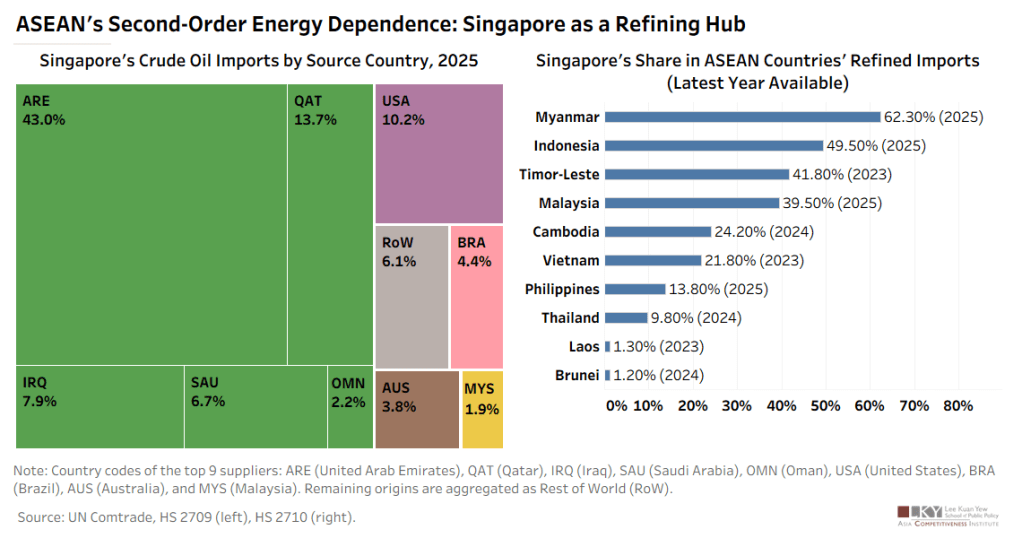
Singapore’s role as ASEAN’s dominant refining hub carries a structural vulnerability that extends well beyond its own borders. Analysis of recent years’ UN Comtrade CIF value data shows that 73.5% of Singapore’s crude oil imports originate from five Middle East suppliers (UAE, Qatar, Iraq, Saudi Arabia, and Oman), with the UAE alone accounting for 43.0%. Because ASEAN countries rely heavily on Singaporean refinery exports, this concentration is transmitted downstream to the region’s energy security as a second-order dependency.
Major suppliers outside the Middle East, namely the United States, Brazil, Australia, and Malaysia, together contribute only 20.3% of Singapore’s crude imports. This diversification is limited in scale and cannot meaningfully offset Middle East supply disruptions, including a closure of the Strait of Hormuz. The exposure this creates is most acute for ASEAN countries with the highest reliance on Singaporean refined products. Myanmar sources 62.3% of its refined oil imports from Singapore, followed by Indonesia at 49.5%, Malaysia at 39.5%, Cambodia at 24.2%, and Vietnam at 21.8%. For these countries, Singapore functions as an intermediary whose supply concentration must be tracked closely in national energy security planning.
This underscores the importance of looking beyond national-level import diversification alone. Regional refining capacity is anchored by Singapore, and is concentrated in selected refineries outside Singapore. Meaningful diversification of ASEAN’s energy security therefore requires attention to the sourcing structure of key regional refineries, alongside the energy import portfolios of individual member states.
Highlights:
1. Middle East suppliers dominate Singapore’s crude sourcing. The UAE alone supplies 43.0% of Singapore’s 2025 crude imports, and the combined Middle East bloc (UAE, Qatar, Iraq, Saudi Arabia, Oman) accounts for 73.5%.
2. Sourcing outside the Middle East is limited in scale. The United States, Brazil, Australia, and Malaysia together supply 20.3% of Singapore’s crude imports, insufficient to offset a Middle East disruption.
3. ASEAN countries inherit this concentration through importing Singapore’s refined output. Myanmar (62.3%), Indonesia (49.5%), Malaysia (39.5%), Cambodia (24.2%), and Vietnam (21.8%) source large shares of their refined oil imports from Singapore, extending Singapore’s Middle East exposure into their own energy security profiles.
Article By Parag, DASS
Graphic By HUANG, Yijia

