Summary:
As digital trade becomes an increasingly ubiquitous part of the global economy, governments are adapting their trade agreements accordingly. Since 2020, these agreements have broadened the range of digital provisions they cover and enhanced their level of commitment.
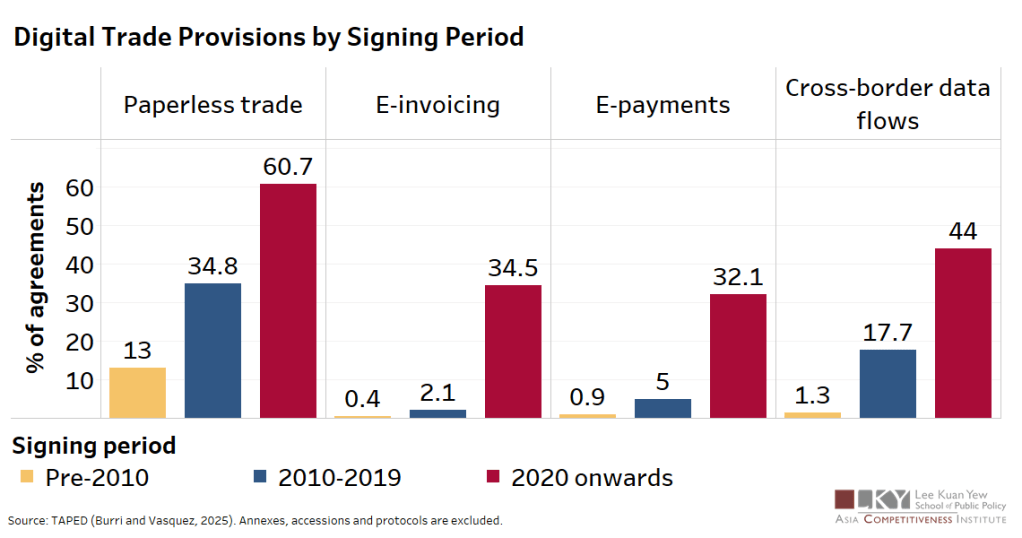
The Chart of the Week illustrates that, since 2020, countries worldwide have signed a much greater share of agreements containing provisions on paperless trade, e-payments, e-invoicing, and cross-border data flows, compared to previous decades. These provisions have not only become more prevalent but also increasingly binding. This trend extends to wider digital-economy topics, particularly digital trust, with growing coverage of personal data protection, online consumer protection, and cybersecurity.
Highlights:
1. Digital provisions are becoming increasingly common. Each of the four provisions shown is substantially more prevalent in agreements signed since 2020. Paperless trade appears in 61.6% of agreements and data-flow provisions in 44.2%. E-invoicing and e-payments now feature in around one-third of agreements—more than six times their respective shares in the previous decade.
2. Digital-trade commitments are becoming more binding, while chapters are becoming more comprehensive. Binding commitments on paperless trade and data flows have more than tripled since 2010–2019, now appearing in 16.3% and 30.2% of agreements, respectively. Furthermore, digital-trade chapters have become much more extensive. Compared with the pre-2010 period, a typical chapter now contains almost three times as many articles and nearly four times as many words.
3. Digitisation extends to digital trust provisions. Since 2020, 64.0% of agreements include personal-data protection, 57.0% online consumer protection, and 47.7% cybersecurity provisions – all sharply higher than in previous decades.
Article By Mukund, KISHORE
Graphic By YAN, Bowen

