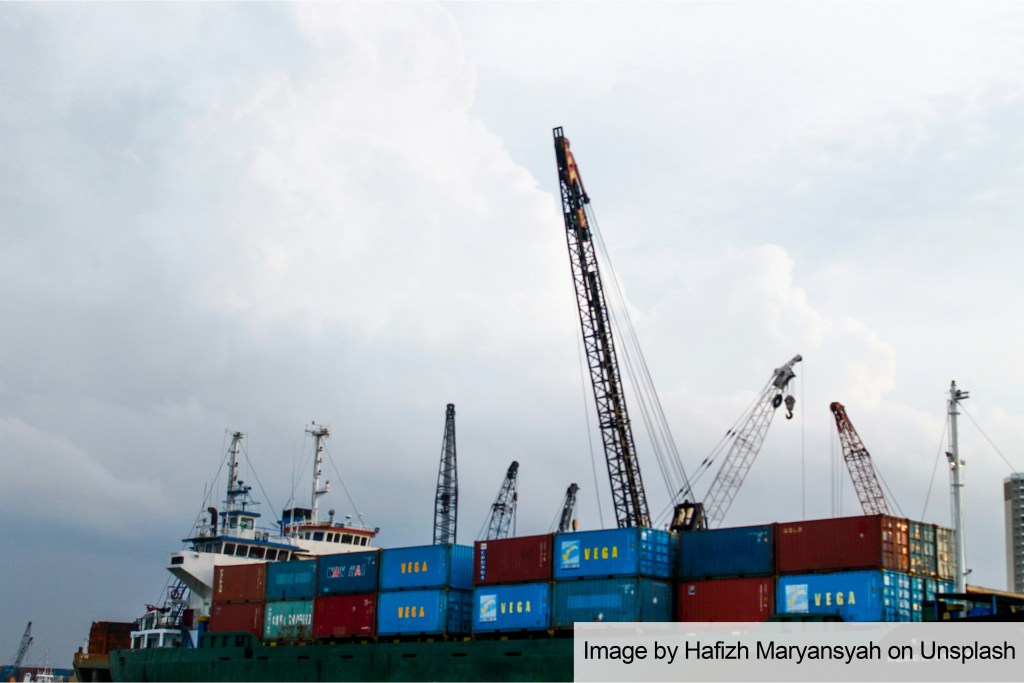
ACI’s latest research how Indonesia’s resource-rich provinces beyond Java can capture more value from maritime connectivity, industrial development, and human capital upgrading. These provinces have strategic locations and abundant natural resources, but moving into higher-value manufacturing depends on the coordinated development of ports, industrial sites, hinterland logistics, and workforce capabilities. West Kalimantan offers a useful case for examining this transition.
Maritime infrastructure has historically played a central role in industrial upgrading. ACI’s paper conducted a cross-country comparison in the region and shows that rapid expansion of deep-water containerised ports in the early 2000s helped accelerate manufacturing growth and regional trade integration. Indonesia, despite being the world’s largest archipelago, has yet to achieve a similar transition. The country has only 1.2 ports per thousand kilometres of coastline, substantially below regional average, while many Indonesian ports remain concentrated in lower global traffic rankings.
The consequences are visible in Indonesia’s domestic economic structure. Java continues to dominate manufacturing and international trade, while provinces in Sumatra, Kalimantan, and Sulawesi primarily supply raw materials and industrial inputs to production centres in Java. These upstream regions rarely export directly to major consumer markets such as the US or EU, with trade instead concentrated in commodity flows to ASEAN and China. As a result, much of Indonesia’s maritime connectivity facilitates the movement of low-value commodities rather than supporting broader industrial upgrading across provinces.
West Kalimantan illustrates these dynamics clearly. The province provides a useful case study because it combines strategic maritime location, abundant bauxite reserves, and ongoing port expansion, yet continues to face significant industrial upgrading constraints. Located between the Strait of Malacca and Java’s manufacturing hubs, West Kalimantan is well positioned to serve as a bridge between regional shipping lanes and Indonesia’s domestic industrial centres. Yet it contributes only 1.1 percent of Indonesia’s total exports, while more than 88 percent of its trade by volume remains domestic. Its dominant export is aluminium oxide: a midstream product derived from bauxite, but still far from the higher-value aluminium metal used in automotive and electronics manufacturing.
West Kalimantan’s challenge is not connectivity alone, but value capture. Completing and operationalising the Port of Tanjungpura must be accompanied by stronger hinterland logistics, industrial site development, and workforce upgrading. The province’s physical infrastructure ranks 32nd out of 34 nationally, while its workforce remains heavily concentrated in primary sector employment and has among the lowest average years of schooling in Indonesia. Infrastructure investment without a broader industrial strategy will not fundamentally shift the province’s role in the national supply chain.
For Indonesia, the policy implication is clear: maritime infrastructure investment must be integrated with industrial development and human capital upgrading. Ports alone will not transform resource-rich provinces unless they are supported by downstream processing industries, stronger hinterland connectivity, and a more skilled workforce. West Kalimantan offers a scalable test case. If these complementary investments can be aligned, the province could become a model for how Indonesia’s resource-producing regions move into higher-value industrial activities and achieve more balanced national growth.
The implications also extend beyond Indonesia. ASEAN supply chains are facing growing pressure to reduce dependence on concentrated single-source inputs. A province with large bauxite reserves, expanding port infrastructure, and proximity to the Strait of Malacca could become an important node in a more resilient regional aluminium network, if the necessary enabling conditions are built. What Indonesia needs now is a credible long-term strategy to close the infrastructure, industrial, and human capital gaps that continue to keep provinces such as West Kalimantan at the periphery of regional trade.
Researchers: LU, Miranda, YI, Xin

