Summary:
The Johor–Singapore Special Economic Zone (JS-SEZ), launched in January 2025, not only affect the policy locations—Johor and Singapore—but also generates spillover effects across other states in Peninsular Malaysia.
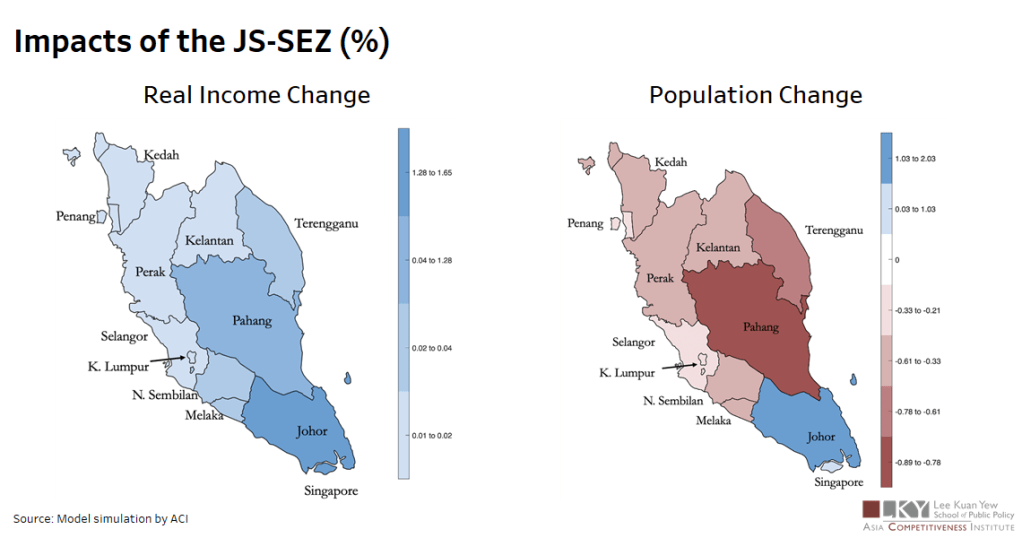
This Chart of the Week, based on recent ACI research, illustrates how the policy is projected to change real wages and population for Singapore and all states in Peninsular Malaysia in 2030. Three main patterns emerge: 1) The JS-SEZ improves real wages across the peninsula; 2) it reallocates labor force in the peninsula toward Johor; 3) the neighbouring states of Johor experience larger adjustments than more distant states.
Highlights:
1. The JS-SEZ raises real wages across all regions in Peninsular Malaysia and Singapore, with gains concentrated in the Johor-Singapore corridor. On average, real wages in Johor and Singapore increase by 1.47 percent in 2030, compared to an average gain of 0.02 percent in other Malaysian states.
2. The policy also reallocates economic activity in the peninsula toward Johor, drawing population from other states. Johor’s Population increase by 2 percent in 2030 due to the policy, while populations in other states decline by 0.4 percent on average.
3. Neighbouring states of Johor experience larger adjustments than more distant states. Real wage gains are stronger in nearby states such as Melaka and Pahang than in more remote states such as Kedah; at the same time, neighboring states also experience larger population outflows.
For Further analysis, please see our working paper: Beyond the Causeway: Spatial Impacts of the Johor-Singapore Economic Zone and Rail Link (Authors: SONG, Yunlong and Adam ROMZI )
Article By SONG, Yunlong
Graphic By YAN, Bowen

