Summary:
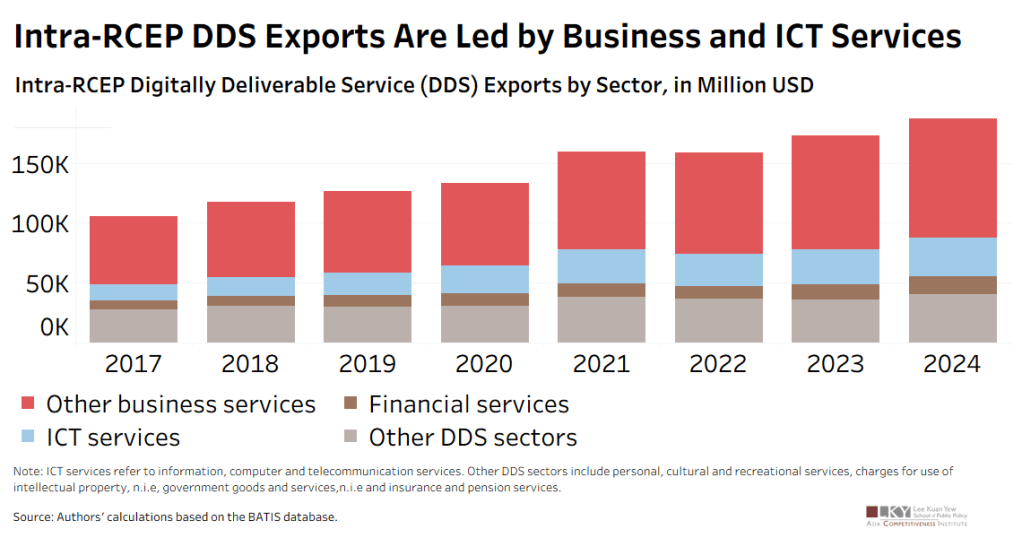
Intra-RCEP exports of digitally-deliverable services (DDS) have demonstrated remarkable resilience, with a compound annual growth rate of 9% from 2017 to 2024, outpacing non-DDS sectors, despite of trade wars, the COVID-19 pandemic, and geopolitical tensions. Looking ahead, the World Trade Organisation projects that the artificial intelligence (AI) boom will boost DDS trade by 42% by 2040, the highest projected growth across all trading sectors.
In 2024, two categories dominated the intra-RCEP DDS exports: other business services and telecommunication, computer, and information services (ICT), jointly accounting for 71% of the intra-bloc exports. This trade was heavily concentrated among Singapore, China, and Japan. Singapore stood as the premier exporter across both categories, with Japan serving as its largest destination market.
Other business services alone represented over half of all intra-bloc DDS exports between 2017 and 2024, surging 77% from USD 56 billion to USD 99 billion. Within this segment, professional services expanded to 44% of the total in 2024, up from 34% in 2017, while technical services saw a moderate contraction from 58% to 49%. Singapore, Japan, and China remained the leading exporters for both.
Within the ICT sector, amounting to USD 32 billion 2024, computer services led decisively, holding approximately 80% of exports since 2017. Singapore commanded this space with a 40% share in 2024, followed by China and South Korea. Meanwhile, information services, though a smaller segment, surged an impressive 252% over the same period, primarily driven by Singapore and China, pushing its share of ICT exports from 5% to 7%.
To capitalise on this AI-driven momentum and further fuel the growth of intra-RCEP DDS trade, the RCEP framework requires an upgrade, notably on targeted provisions on emerging technology cooperation, such as AI and fintech. Member countries should draw on best practices from parallel free trade agreements (FTA), such as the ASEAN-China FTA 3.0, the Digital Economy Partnership Agreement (DEPA), and the Korea-Singapore Digital Partnership Agreement, embedding frameworks for knowledge and industrial practice sharing, fostering innovation ecosystems and exploring commercialisation opportunities, and aligning AI governance framework with internationally-recognised principles and guidelines.
Highlights:
1. Other business services alone represented over half of all intra-RCEP DDS exports between 2017 and 2024, surging 77% from USD 56 billion to USD 99 billion, led by professional services.
2. Intra RCEP exports of information services surged an impressive 252% from 2017 to 2024, largely driven by exports from Singapore and China.
3. To further fuel the growth of intra-RCEP DDS trade in the AI era, RCEP needs to upgrade its framework to include provisions for sharing best industrial practices, exploring commercialisation opportunities, and aligning AI governance frameworks across member countries.
Article and Graphic by: HUANG, Yijia
Note:
1. DDS trade is defined as international transactions that can be delivered remotely over computer networks, such as financial services, telecommunication, computer and information service and business services.
2. Other business services include technical, trade-related, and other business services, professional and management services, and research and development services.
 ACI Perspectives