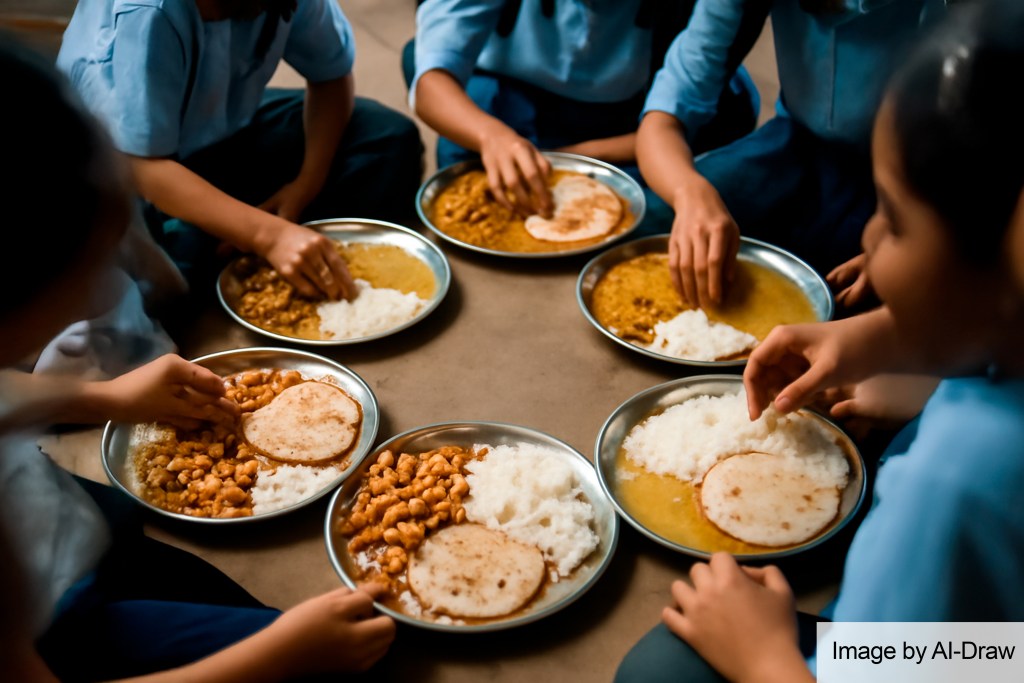
Can a school meal programme also reduce child labour? New research from the Asia Competitiveness Institute finds that India’s Midday Meal Scheme substantially reduced child labour among 10- to 15-year-olds in upper primary grades. This matters especially in economies that depend heavily on informal and agricultural work, where child labour is not only a welfare issue but also affects human capital, household resilience, and long-term productivity.
India’s Midday Meal Scheme generated benefits beyond its original policy aims. Designed to improve nutrition and school participation, especially for poorer children, it is the world’s largest school feeding initiative and provides meals each school day in government and government-aided schools. Starting in 2007, the scheme was extended to upper primary grades through a phased rollout across states. Although the programme was expected to support school participation, reducing child labour was never an explicit target.
The headline finding is that the programme sharply reduced child labour. Child labour among 10- to 15-year-olds fell by 3.4 percentage points, equivalent to a 47 percent reduction relative to children not yet covered by the scheme during the same period. This suggests that school feeding unintentionally changed how households allocate children’s time.
The main effect came from reducing household labour rather than work outside the home. Chores, domestic work, and unpaid work in family enterprises are less visible forms of child labour, but they can still undermine schooling. A likely reason for the decline is that the meal increased school attendance for both boys and girls, giving families a stronger reason to keep children in school and less time available for work.
The strongest gains appeared among children facing the greatest work pressure. Older children, especially those aged 13 and above, saw the largest declines. The programme also had particularly strong effects in agricultural households, where children are often drawn into domestic and farm-related work. Benefits were seen across both poorer and richer households, but they were more pronounced among poorer families, where children’s labour is often more central to household survival.
The gender pattern becomes sharper when looking at the type of work reduced. For girls, the decline came mainly through fewer household chores. For boys, the programme reduced unpaid work in household enterprises. This distinction matters for policy because boys’ and girls’ labour burdens often differ even when the overall reduction in child labour looks similar.
The programme also appears to have shifted some work onto siblings. When treated children spent more time in school, some household chores seem to have been taken up by other children in the family, especially older sisters. This does not negate the programme’s gains, but it shows that household welfare interventions are not frictionless and may create hidden burdens within families.
For policymakers, the broader lesson is practical: well-designed government welfare schemes can generate benefits beyond their original aims. School feeding should be viewed as part of a broader child welfare strategy. Its returns go beyond nutrition to include stronger school participation and less child labour, especially for older children and those in agricultural households. This underscores the need for more targeted policymaking and greater attention to longer-term impacts.
Researchers: CHAWLA, Vardaan, FUJII, Tomoki, KHANNA, Arpita, RAY, Rohan

