Summary:
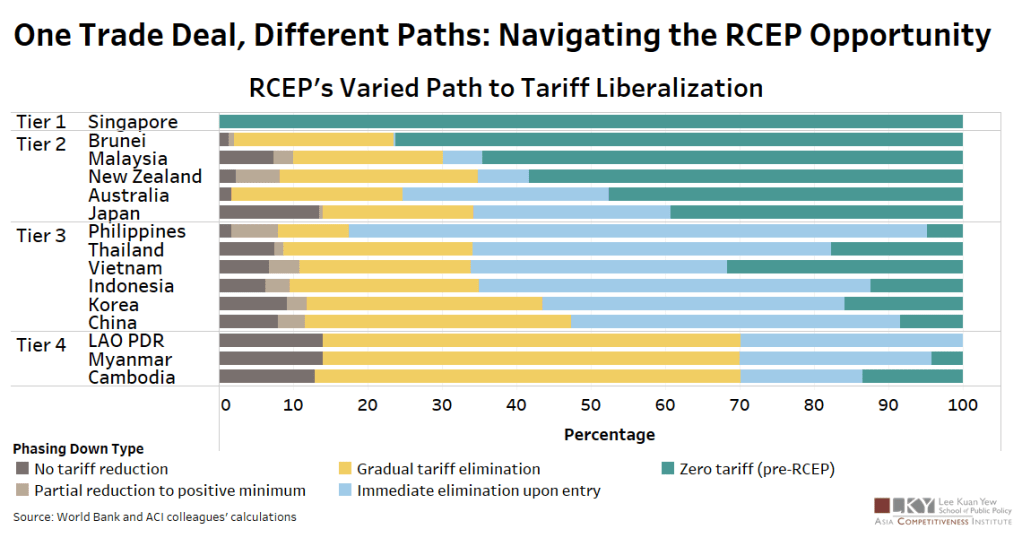
As the world’s largest free trade agreement, Regional Comprehensive Economic Partnership (RCEP) creates a common framework for its 15 member countries, but the path to tariff liberalization is not uniform across the region. A multi-paced approach is noticeable, with nations grouped into four distinct tiers based on their liberalization strategies.
At the forefront is Singapore, with its immediate implementation of zero tariffs on all goods. A second tier of highly open economies—including Australia, Japan, New Zealand, Malaysia, and Brunei—already had over 40% of their tariffs at zero pre-RCEP and are moving quickly to eliminate more. In the third tier, countries like China, Korea, Indonesia, the Philippines, Thailand, and Vietnam are taking a hybrid approach; while they have a lower share of zero-tariff products, they are making significant and immediate tariff cuts on many goods. Finally, developing ASEAN members such as Cambodia, Laos, and Myanmar form the fourth tier, relying heavily on gradual tariff reductions over time. This cautious strategy may give their local industries an adjustment period to adapt to rising competition.
For businesses, this staggered liberalization means that while the RCEP framework is unified, the opportunities within it will unfold at different speeds, requiring distinct strategies for quick-entry markets versus those that will open more slowly.
Highlights:
1. While RCEP creates a common framework, countries are opening their markets at their own paces, creating a diverse and multi-speed landscape for international businesses.
2. This means some markets will offer immediate opportunities for expansion, while others will require a more cautious and long-term strategic approach.
Article By LU Miranda
Graphic By YAN, Bowen
 ACI Perspectives