Summary:
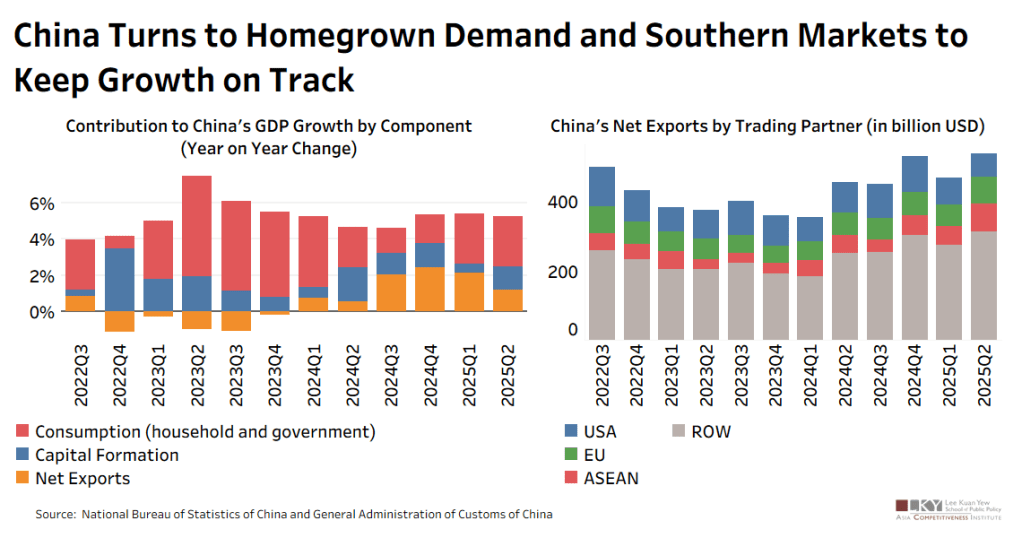
China’s post-lockdown GDP growth has been driven mainly by domestic consumption amid weak external demand and global trade disruptions. This growth has been supported by strong fiscal and financial measures by the government to boost spending. Despite a brief export boom in late 2024 that largely lifted GDP, growing external uncertainties, including U.S. tariff disputes, have reinforced the government’s prioritization of “domestic circulation” as the core growth strategy.
To sustain GDP growth around 5%, China is expanding its presence in emerging markets across the Global South through multinational frameworks such as the Belt and Road Initiative (BRI) and the Regional Comprehensive Economic Partnership (RCEP), alongside bilateral diplomatic efforts. While exports to the EU and U.S. have plateaued or declined due to tariffs and trade frictions, demand from ASEAN economies has remained robust, particularly for Chinese electronics, automobiles, and machinery serving as intermediate inputs in manufacturing.
Highlights:
1. Domestic consumption continues to be the primary engine of China’s GDP growth, underscoring the strategic focus on “domestic circulation” to sustain stable, moderate expansion.
2. Net export growth increasingly depends on emerging markets, with burgeoning demand from ASEAN and other Global South economies offsetting declines in shipments to the U.S. and Western Europe amid ongoing trade tensions.
3. The composition of China’s GDP growth reflects a dual strategy of stimulating internal consumption and diversifying external trade, signaling China’s ambition to enhance domestic brands’ competitiveness and position them as key players in South-South trade.
Article By LIAN, Huiyuan
Graphic By HUANG, Yijia
 ACI Perspectives