
Trade expansion and the promotion of environmental sustainability may be conflicting activities: liberalizing trade can raise carbon emissions from pollution-heavy production, trade-related fossil fuel combustion, and generally heightened resource-intensive economic activity. But trade can also facilitate greater flows of sustainable goods and services, green production practices, and technology transfer. To reconcile these opposing outcomes and obtain the best of both worlds, policymakers have begun incorporating ‘green clauses’ in their free trade agreements. Nevertheless, these environmental provisions have done little to mitigate the damaging effects of trade-induced climate change.
In exploring the trade-environment nexus, there is value in examining ASEAN’s efforts to address and promote green trade, given its rapid economic growth and its expeditious integration into global trade networks. The region is highly vulnerable to the ravages of climate change and researchers have opined that its meteoric growth comes at the compromise of its environment. A recent study by researchers at the Asia Competitiveness Institute (ACI) has found that while the ASEAN region is a net exporter of emissions, it is also a net importer of environmental goods. Nonetheless, in the global arena, its contribution to both production- and demand-based emissions is lower than other economies in Asia, North America and Europe.
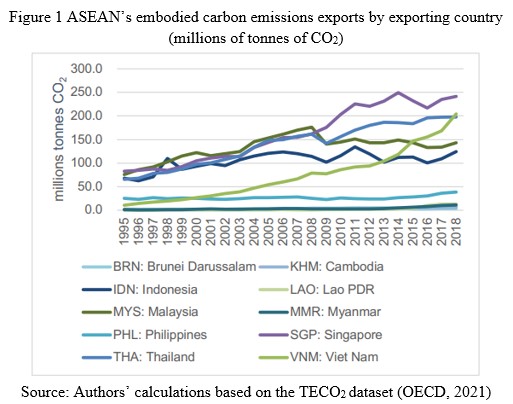
Upon decomposing the regional embodied carbon emissions in exports by member countries, Vietnam’s contribution has risen by the greatest magnitude – from 14.2 million tonnes to 204.3 million tonnes of CO2 from 1995 to 2018 due to its rapid growth as a producer and exporter. On the contrary, Brunei, Myanmar, Laos, and Cambodia have the lowest export-embodied emissions (Figure 1). Authors attribute the upswing in emissions in exports (and imports) to the large intra-Asian trade growth – during the same time period, export- and import-embodied emissions in trade flows within Asia have soared by more than three times, from 150 million tonnes to 530 and 450 million tonnes, respectively.
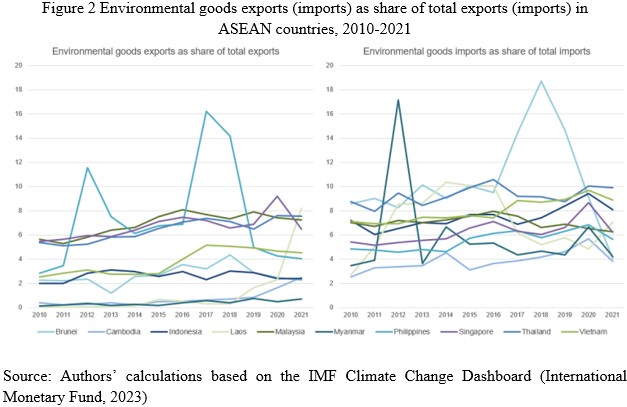
Simultaneously, ASEAN is also a net importer of environmental goods, with its imports outpacing exports by 30%. ASEAN’s environmental goods trade has also been commensurate with the world average between 2012-2021, its share oscillating between 6.3% and 7.2%. However, there has been no significant growth of environmental goods as share of total trade, indicating no heightened interest in trading these goods in recent years (Figure 2).
Similarly, ASEAN policymakers’ interest in the issue also seems to have stagnated in the past decade, given the absence of significant growth in the inclusion of environmental clauses in ASEAN member-countries’ preferential trade agreements (PTAs). Singapore stands out in this regard, having signed the Singapore-Australia Green Economy Agreement (GEA) in October 2022. Its explicit emphasis on the green economy and its interconnectedness with economic growth and its focus on partnerships and cooperation in sustainable trade, provides a more promising alternative to traditional disconnected environmental chapters in PTAs.
Therefore, individual ASEAN economies as well as the region as a whole have much to gain from negotiating more GEA-style agreements, even if initially executed at a smaller scale, to better address the confluence of economic growth and environmental sustainability.
Researchers: GEORGE, Ammu, SENGSTSCHMID, Ulrike and XIE, Taojun
 ACI Perspectives