
The export structures of China and Vietnam have been increasingly similar due to their close geographic proximity and similar comparative advantages in labor-intensive industries. Recent events such as the US-China trade war and the COVID-19 pandemic have had potential impacts on foreign direct investment (FDI) inflows into both countries due to the similarity. A study by ACI found a significant FDI inflow to China was redirected to Vietnam starting in 2017 due to the trade war.
The study seeks to answer two questions. Firstly, whether there is a significant redirection in FDI from China to Vietnam from 2013 to 2022. Secondly, if the trade war between the US and China – the two largest trading partners of Vietnam, led to a shift in FDI from China to Vietnam from 2018 to 2019.
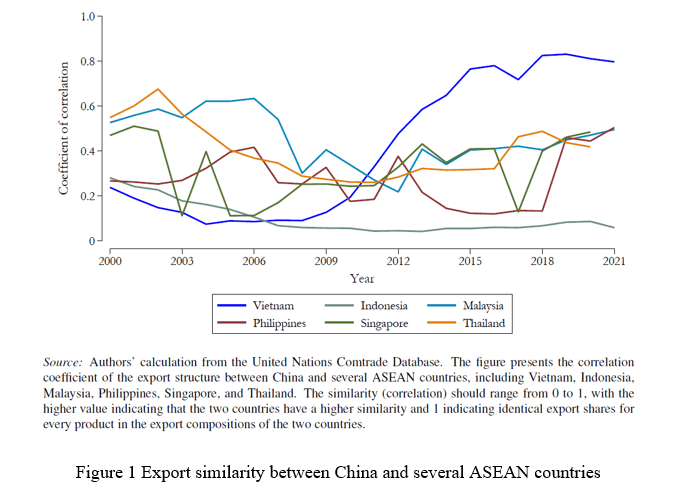
Vietnam is selected for three reasons. Firstly, existing literature has focused on the impact of the trade war on the US and China, with little attention given to neighboring Southeast Asian countries. These countries, with similar comparative advantages in labor-intensive industries, relatively cheap labor, and geographic proximity to China, could benefit from the trade war. Vietnam, in particular, shares the greatest similarity in export structure with China. Figure 1 shows Vietnam’s remarkable and consistent increase in export similarity with China since 2009, making it a prime alternative for FDI amid the trade war.
The authors first conducted an event study to examine the trend in FDI inflows into China and Vietnam using data from the Orbis Crossborder Investment Database and the information on tariffs imposed by the US and China from 2018 to 2022. They found that there was a significant shift in FDI inflows from China to Vietnam during this period. From 2017, the total FDI inflows into Vietnam, relative to China, has increased by more than twofold compared to the gap in 2013. Additionally, the rise in the tariffs imposed on Chinese goods by the US between February 2018 and October 2019 significantly reduced FDI inflows into China. A substantial portion of this FDI was redirected to Vietnam as a consequence of the tariff escalation by the US.
The authors then employed the difference-in-differences (DID) specification to examine the difference in FDI between Vietnam and China among products targeted by the increased tariffs before and after the trade war. According to the authors, a one percentage point increase in US import tariffs, relative to the average monthly level, reduced FDI inflow to China by 0.6% to 1.6% compared to the pre-trade war period. Of this reduction, approximately 3% was redirected to Vietnam, contributing to the growth of FDI in the country. On the other hand, China’s retaliatory tariffs did not have a discernible effect on foreign investment in China and Vietnam, during the same period.
However, the negative impact from the increased US import tariffs is only notable in the short run. The DID results from October 2019 to December 2022 were not statistically significant. This shows that as the trade war unfolded and persisted over time, foreign firms may have adapted to the trade tensions and are able to adjust their strategies and supply chains to mitigate the risk and uncertainty.
Additionally, though the Phase One Agreement signed by the US and China in January 2020 marked a truce of the trade war, the DID results from 2020 to 2022 implied a continued high amount of FDI shifting from China to Vietnam. This might be partially due to the COVID-19 pandemic. During the period, China imposed stringent border control measures discouraging foreign investors from investing in China, while Vietnam maintained relatively open borders, making it a more attractive investment destination.
In summary, ACI’s study underscores the significant role of tensions and shocks, such as trade wars and global crises, in reshaping investment preferences and destinations. These impacts can extend to countries not directly involved in the conflicts, particularly those with similar comparative advantages as the affected nations.
By HUANG, Yijia
Researchers: BANH, Thi Hang, FAN, Litianqi and ZHANG, Xuyao
 ACI Perspectives