
The Comprehensive and Progressive Agreement for Trans-Pacific Partnership (CPTPP) contains a comprehensive chapter on intellectual property (IP) protection. The is designed to simplify the processes of searching, registering, and safeguarding patents within CPTPP markets. In addition, it aims to elevate the minimum standards for the enforcement of IP protection. The goal is to create an environment that is conducive to sharing and collaborating on intellectual property across the member countries.
A study conducted by ACI explores the innovation and knowledge exchange landscape among CPTPP member countries from 2010 to 2019. It reveals that, although there is a significant exchange of knowledge within the bloc, the scale of this exchange is notably smaller compared to collaborations with countries outside the CPTPP. Consequently, the authors recommend enhancing collaboration among CPTPP nations to fully tap into the potential offered by the CPTPP’s IP Chapter.
The member countries of the CPTPP show a varied range of comparative advantages in technological specialization. Looking from the perspective of the origin countries, where patents are invented, nations like Australia, Canada, Malaysia, Singapore, and Vietnam are more focused on high-tech industries, such as Pharmaceuticals and Computers & Electronics. In contrast, Mexico and Peru tend to specialize more in medium-low and low-tech industries, including Furniture, Printing, and Paper. From the viewpoint of recipient countries, where these technologies are applied, Malaysia and Singapore emerge as prominent adopters of high-tech innovations.
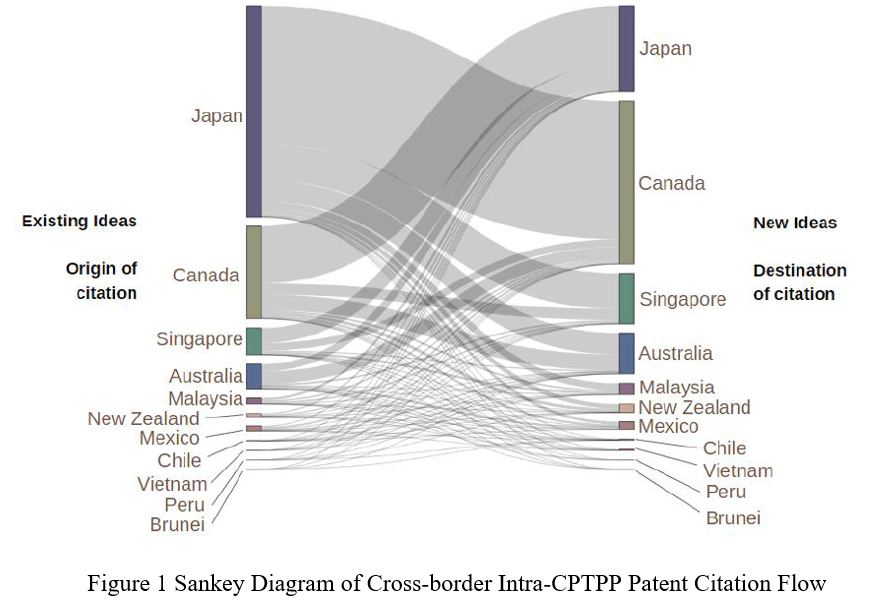
The diverse comparative advantages among CPTPP parties offer rich opportunities for the exchange of knowledge and innovation within the bloc. As illustrated in Figure 1, knowledge transfer among CPTPP members is well interconnected. Japan, Canada, and Singapore, being the largest sources of citations, are the primary generators of knowledge within the bloc, indicating a strong inclination towards innovation in these countries. Concurrently, they are also the main recipients of knowledge within the bloc. Notably, Canada emerges as the foremost destination for citations, highlighting its significant role in the transfer of knowledge.
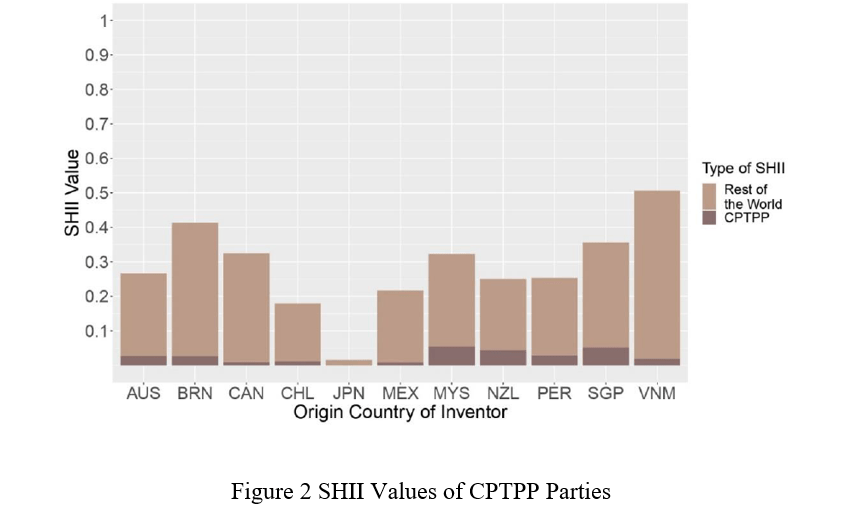
However, a comparison between collaboration within the CPTPP bloc and those with external partners in R&D activities shows that R&D collaboration within the CPTPP is relatively limited. Figure 2 compares the intra-bloc and international R&D collaboration of individual CPTPP parties. The SHII value, which measures the extent of the cross-border collaborative invention of the country, is used for this analysis. For most CPTPP parties, their intra-CPTPP SHII values are modest, compared to collaborations with the rest of the world. Even for nations like Singapore and Malaysia, which have the closest R&D ties with the CPTPP members, their intra-bloc collaboration represents only a small portion of their international R&D efforts. This indicates that while global R&D activities are flourishing, the collaborative efforts within the CPTPP bloc are less prominent, suggesting huge untapped potentials for deeper cooperation under the CPTPP framework.
This research offers valuable policy implications. Despite rich R&D interconnections between CPTPP parties from 2010 to 2019, the intra-bloc R&D collaboration is limited. Considering the diverse comparative advantages possessed by the member countries, there is huge potential for further intra-bloc R&D cooperation in the future. CPTPP members should fully leverage the potential for knowledge exchange and cooperative innovation within the bloc. By doing so, they can further enhance their collective capabilities and foster a vibrant ecosystem of research and development.
By HUANG, Yijia
Researchers: TAN, Faith, XIE, Taojun and ZHANG, Chi
 ACI Perspectives