Summary:
The Digital Services Trade Restrictiveness Index (DSTRI) is a comprehensive assessment tool developed by the OECD. It compiles data from publicly available laws and regulations in various countries to gauge their trade and investment openness within the digital sphere. This index employs a scale ranging from 0 to 1, where 0 signifies a highly permissive regulatory environment for digital trade, and 1 represents a completely sealed-off system.
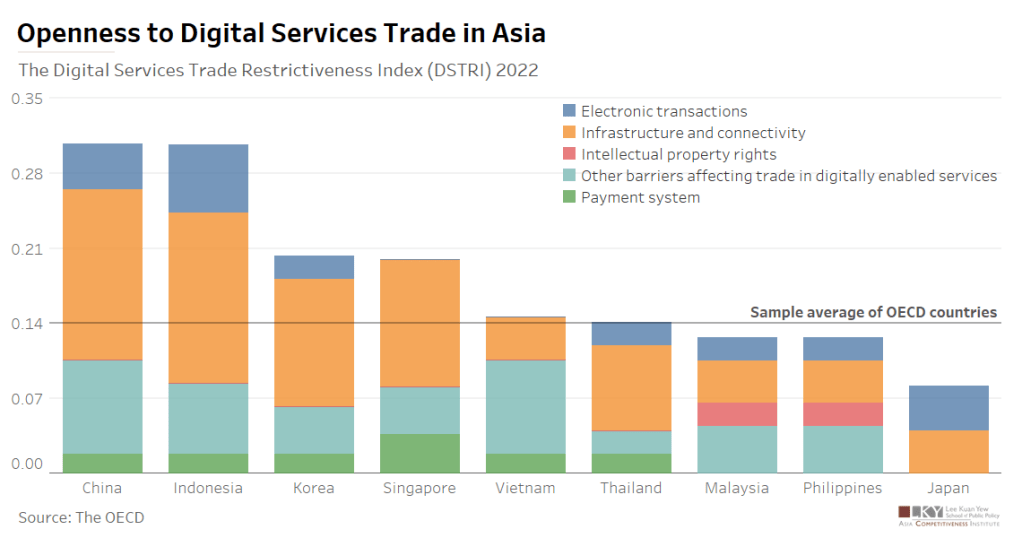
Among the selected Asian nations, most of their DSTRI scores falls above the OECD average. China and Indonesia are the countries exhibiting the most stringent restrictions, followed by South Korea and Singapore. Remarkably, Japan stands out as the most liberal in this context.
A closer examination reveals that constraints primarily revolve around most of these countries’ infrastructure and connectivity segments. This category encompasses issues such as the interconnectivity of communication infrastructure, which has become increasingly significant due to numerous countries implementing policies to enhance the oversight of cross-border data transmission in recent years. The second most prevalent set of limitations pertains to other barriers affecting trade in digitally enabled services. Notably, Vietnam, Malaysia, and the Philippines reported the highest incidence of these measures. These restrictions may involve constraints on activities like downloading and streaming, as well as regulations affecting online advertising.
Highlights:
- The 2023 Digital Services Trade Restrictiveness Index (DSTRI) reveal that many Asian economies, such as China, Indonesia, Korea and Singapore, have DSTRI scores above the OECD average, indicating relatively strict regulatory environments for digital services trade.
- For most countries, the infrastructure and connectivity segment accounts for the highest share of DSTRI. This is related to the fact that in recent years, many countries have successively introduced relevant laws, regulations, and policies to strengthen the supervision of cross-border data transfers.
Article & Graphic By GE, Yixuan
 ACI Perspectives