China’s accession to the WTO in 2000 often dubbed the “China shock”, had far-reaching effects that rippled through economies worldwide. As an economy geographically and economically close to Mainland China, Taiwan has also been largely impacted by the China Shock. A study by ACI asks whether the impact of China Shock is different between developed economies and developing economies such as Taiwan. It also studies the impact of Taiwan’s accession to the WTO on its labour market. Specifically, the process of re-skilling and up-skilling the workforce enhances the strength of star sectors that rely heavily on skills for exporting. This not only enhances their competitive advantage but also generates benefits that ripple across various sectors of the economy.
Taiwan is an interesting case for two reasons. Firstly, it shares close and complementary trade relations with Mainland China, especially within the manufacturing sector. In the product lifecycle, Taiwan specializes in producing intermediates, such as semiconductor components, while China excels in the production of final goods. This makes them collaborators in the industry. Secondly, Taiwan holds a unique economic position, being more developed than Mainland China but lagging behind the US. Moreover, it joined the WTO shortly after China’s accession, amplifying the potential impact of the China shock, especially on its manufacturing industry.
Post-WTO accession, Taiwan underwent substantial tariff reductions, both for imported goods and its own exports. Taiwan lowered its import tariffs for agricultural products, leading to a significant increase in agricultural imports. This intensified competition for locally produced agricultural goods and thereby reduced labour demand. From 1997 to 2005, Taiwan’s agricultural sector experienced a significant labour outflow. Employment within agriculture declined by 4% of its labour force in 1995, primarily affecting low-skilled labour, compelling them to seek employment opportunities in the manufacturing and services sector.
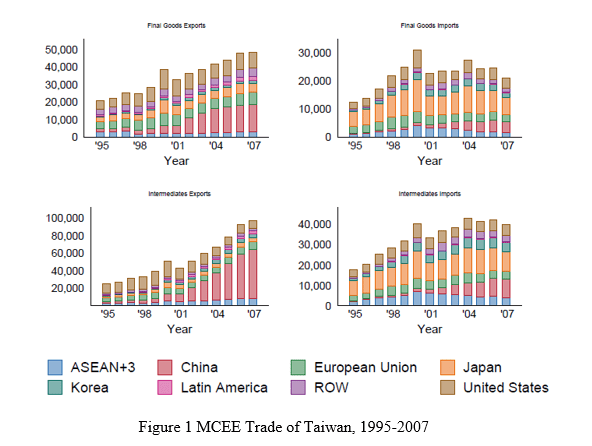
Other WTO members reduced their tariffs significantly for Taiwan’s manufacturing products, especially in Machinery, Computer, Electronics & Electrical Machinery (MCEE). These two sectors emerged as the driving forces behind Taiwan’s exports. The export of Taiwanese MCEE intermediates grew by 286% and the final goods increased by 133% from 1995 to 2007.
The MCEE export growth was primarily fuelled by its exports to Mainland China. As Figure 1 shows, the MCEE intermediates exports to China skyrocketed by 2634.8% and the final goods surged ninefold. This is because Mainland China, historically maintaining high tariff barriers for its exports, significantly lowered its tariffs on Taiwanese products. Additionally, the two economies have strong complementarity in the manufacturing sector, especially within MCEE.
The thriving export of MCEE intermediates bolstered the demand for middle- and high-skilled workers in Taiwan, as these products are inherently skill-intensive. Consequently, a labour inflow into the MCEE industry occurred especially in skilled workers. MCEE’s employment share increased by 5.2%. Among all sectors, workers’ average years of schooling were the highest in MCEE. This allowed us to observe a skill upgrade within the MCEE sector, highlighting the responsiveness of Taiwan’s labour market to the changing economic landscape. In response, the Taiwanese government increased its investment in education to nurture human capital and further empower this skill upgrade process.
Unlike developed economies, where the China Shock negatively impacted their labour market, Taiwan’s labour market benefited from the China Shock. This shows that the impact of accession to free trade agreements is highly contingent on an economy’s economic structure, comparative advantage, labour composition, and trade relationships with other member economies. There is no universal narrative that applies to all economies joining free trade agreements. Taiwan’s story, in particular, underscores the intricate interplay between trade liberalization, sectoral shifts, and skill upgrades within its labour market.
By HUANG, Yijia
Researchers: CHANG, Pao-li, CHEN, Yi-Fan, HSU, Wen-Tai, YI, Xin
 ACI Perspectives