Summary:
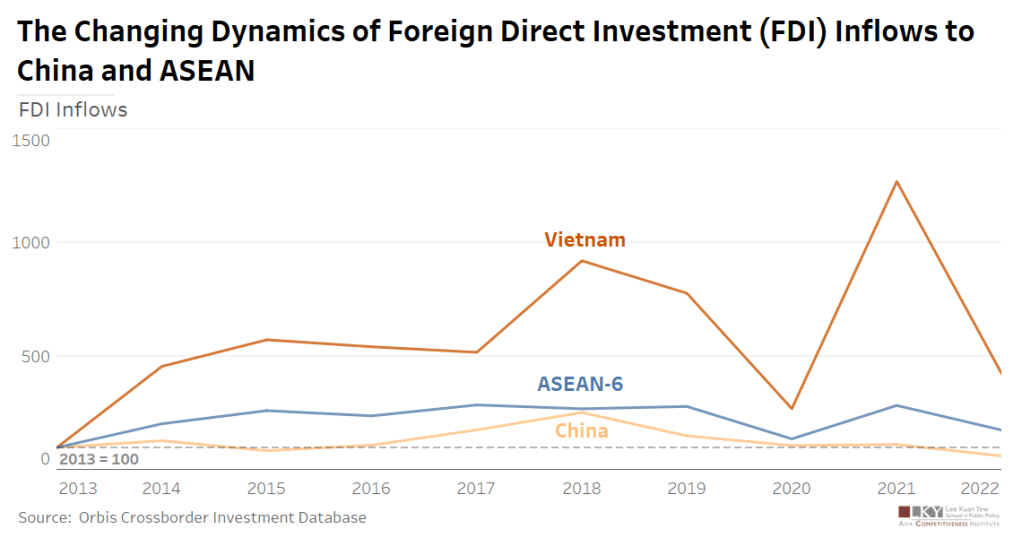
The FDI inflows into China and ASEAN countries have fluctuated over the years. Gobal events, including the US-China trade war and the Covid-19 pandemic, have brought challenges and opportunities for China and Southeast Asian nations. The graph shows the FDI inflows to China, Vietnam, and ASEAN-6 (Vietnam, Malaysia, the Philippines, Thailand, Indonesia, and Singapore) relative to their FDI inflows in 2013. The ASEAN-6, in total, have witnessed a higher growth in FDI inflows compared to China. In particular, Vietnam has stood out with large FDI inflows. As a country sharing similar comparative advantages to China, such as low-cost labour and geographic proximity, Vietnam received a remarkably higher amount of FDI during the US-China trade war from 2018 to 2019. Although Covid-19 pandemic adversely affected Vietnam’s inward FDI, Vietnam experienced a strong recovery of FDI inlows in 2021. China’s ongoing border control measures may have led to a reallocation of inward FDI from China to Vietnam. Vietnam’s FDI recovery seems short-lived as the FDI dropped in 2022 amid the Russia-Ukraine war.
Highlights:
- Compared to China, the ASEAN-6 (Vietnam, Malaysia, the Philippines, Thailand, Indonesia, and Singapore) have witnessed a higher growth in FDI inflows relative to 2013.
- Vietnam received a remarkably higher amount of FDI during the U.S.-China trade war from 2018 to 2019.
- Despite the initial impact of the Covid-19 pandemic on FDI receipts, Vietnam has shown notable growth in FDI in the second year of the outbreak.
Article By FAN, Litianqi
Graphic By GE, Yixuan
 ACI Perspectives